Clarifying the CFP® Certification Experience Rules for an Internship

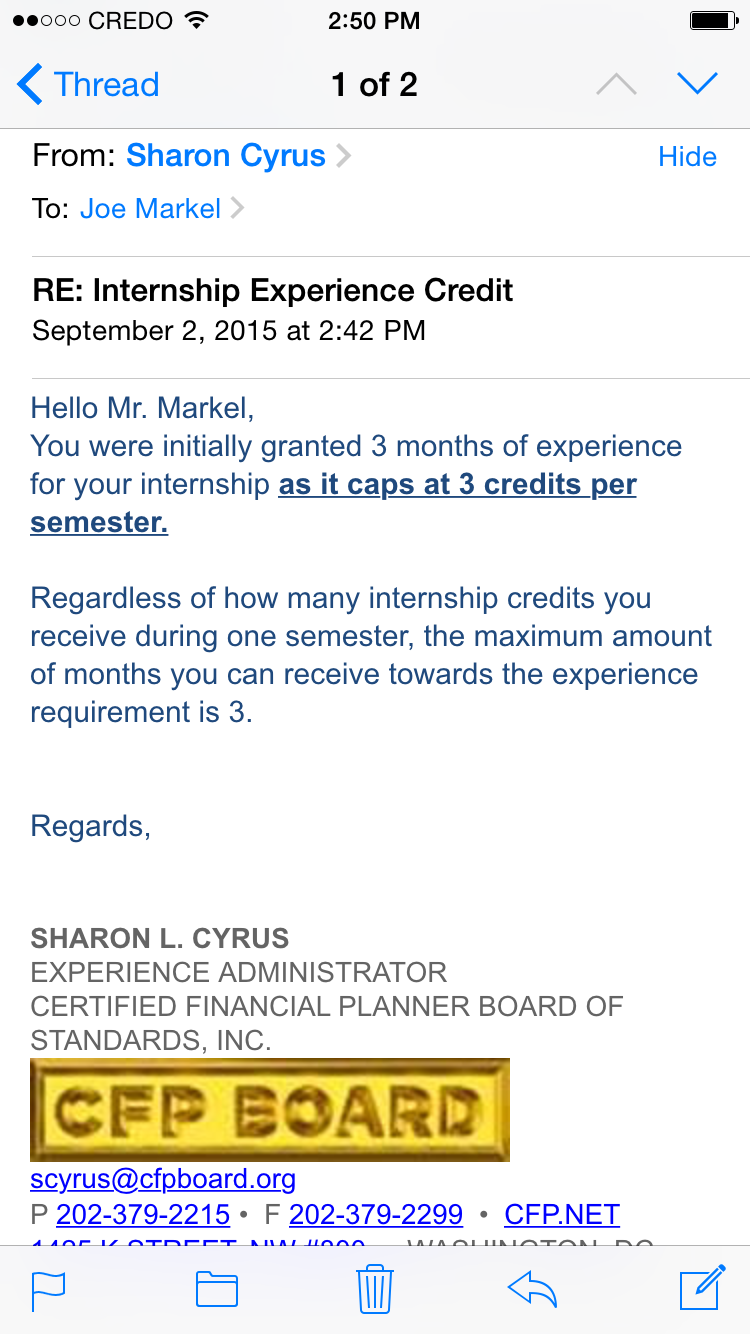
I graduated from a CFP® Board-Registered Program, Alfred State College (SUNY), in May 2014 and completed a required internship as part of that program. According to the CFP® website under the "Experience Definitions,” "financial planning-related internships completed at a CFP® Board-Registered Program are eligible for credit toward the 3 year Experience requirement at the rate of one month of experience for each college semester credit.” (See the screenshot from the CFP® board website below) The internship I completed was 12 credits as indicated on my transcript, which I submitted to the board to complete the education requirement.

The location of this screenshot can be found at the bottom of the page here.

Despite this, the rules regarding internships are apparently slightly different. 

If you attend a CFP® Board Registered Program and complete an internship as part of this program, understand that despite the one credit equals one month of experience message on the website, you will receive a maximum of three months credit towards CFP® certification.

Note: CFP® Board Registered Program internships do not apply for the 2 year apprenticeship option

Risk Versus Uncertainty Revisited

In The Art of Thinking Clearly the author, Rolf Dobelli, explains the following experiment:

Two boxes. Box A contains one hundred balls: fifty red and fifty black. Box B also holds one hundred balls, but you don’t know how many are red and how many are black. If you reach into one of the boxes without looking and draw out a red ball you win $100. Which box will you choose: A or B? The majority will opt for A.

Let’s play again, using exactly the same boxes. This time, you win $100 if you draw out a black ball. Which will you go for now? Most likely you’ll choose A again. But that’s illogical! In the first round, you assumed that B contained fewer red balls (and more black balls), so, rationally, you would have to opt for B this time around.

Don’t worry; you’re not alone in this error - quite the opposite. This result is known as the Ellsberg Paradox - named after Daniel Ellsberg, a former Harvard psychologist. The Ellsberg Paradox offers empirical proof that we favor known probabilities (box A) over unknown ones (box B).

I have written before about the difference between risk and uncertainty.  Risk is calculable. That is, the odds are known. Uncertainty is not calculable. The odds are unknown. Time and time again in the investment management industry risk and uncertainty are confused for each other, which causes major problems.

Risk and uncertainty are both aspects of two different types of problems, complicated and complex, which also happen to be confused for each other. A complicated problem contains risk. It is like building a rocket ship. A blueprint to building a rocket ship can be replicated because building a rocket ship involves risk: it is calculable. On the other hand, a complex problem contains uncertainty. It is like raising a child. Raising one child the same as another often yields different results because raising a child involves uncertainty: it is not calculable. In the investment world, uncertainty (not calculable) is frequently mistaken for risk (calculable) with disastrous results. 

Dolbelli continues:
The difference between risk and uncertainty also illustrates the difference between life insurance and credit default swaps. A credit default swap is an insurance policy against specific defaults, a particular company’s inability to pay. In the first case (life insurance), we are in the calculable domain of risk; in the second (credit default swap), we are dealing with uncertainty. This confusion contributed to the chaos of the financial crisis in 2008. If you hear phrases such as ‘the risk of hyperinflation is x percent’ or ‘the risk to our equity position is y,’ start worrying.

We do not like uncertainty; however, we live in an uncertain world. One would be well-advised to frequently pause to ask oneself if they are dealing with calculable risk or incalculable uncertainty before making any major decisions.

A Short Break

This past week I took three days off from work. During this time, I went with my Grandparents to their farm in Western New York. Their farm is important to me because I spent a lot of time there during the summer as a child. 

Generally speaking, there are two types of vacations: 1) those where you do lots of activities, don’t get much sleep, and have a lot of new experiences and 2) those where you relax. This was the latter. My Grandparent’s farm is surrounded by Amish on almost all sides, has no TV, cell service, or computer, and gets no newspaper. This is a welcomed change from the hecticness of daily life.

It had been a while since I had a vacation. This was my first since joining my current firm in CT, and the first break I have had in a few years. Last summer I was studying for the CFP® examination and the summer before I was studying for the Series 65 examination. As a result, I was greatly looking forward to having a short break where I didn’t have something hanging over my head.

My days at the farm consisted mostly of the following: I would wake around 5:30am. After getting dressed, I would take a book to the back porch overlooking the fields and woods and read for about 60 minutes. The farm is located in a valley of sorts, and as I sat there reading I could hear roosters crowing from the neighboring farms. Around 6:30am my Grandma would bring out coffee and join me. I would go back to reading until my Grandpa was awake. At this point, my Grandma would make a second round of coffee, the first for my Grandpa, and he would join me on the porch while she went in to prepare breakfast. After breakfast, the rest of the day consisted of completing any farm work needing to be done, further reading, and napping. One night we had a campfire in the evening which was nice. Overall, it was very relaxing.

I could have done anything during my three days off from work, but it was important to me to go to my Grandparent’s farm. Aside from the personal reasons, I went to the farm because it offers a change from my usual day-to-day. According to Tim Ferriss, “alternating periods of activity and rest is necessary to survive, let alone thrive. Capacity, interest, and mental endurance all wax and wane. Plan accordingly.” When I was in school, I would always enjoy going from the classroom with notes, computers, calculators, cell phones, and lecture halls to my Grandparent’s farm with trees, animals, campfires, tractors, and barns. As Anatole France said, “Man is so made that he can only find relaxation from one kind of labor by taking up another.” This is even more applicable for me now. It is refreshing to go from mental work to physical work. I spend a lot of time with meetings, emails, and computers. Having a few days without all that is the exact change I occasionally need. However, it is not enough to simply turn off the cell phone and television. For me, the farm offers more than that. In Walden, Henry David Thoreau writes “I went to the woods because I wished to live deliberately, to front only the essential facts of life, and see if I could not learn what it had to teach, and not, when I came to die, discover that I had not lived.” Spending time closer to the outdoors, and being fairly isolated with no computer, cell phone, or television is therapeutic for me. While I am glad to get back into my work routine, I do greatly value these occasional trips to my Grandparent’s farm.